How Long Does Charred Timber Last? The Science Behind the Claim
How Long Does Charred Timber Last? The Science Behind the Claim
Most suppliers state that charred timber lasts 50 years or more. The claim is correct, but only when the charring is done properly. This page explains the material science behind it, and sets out honestly what has to be true for those numbers to hold.
So how long does charred timber last in practice? At Grain & Fire Timber the answer depends on the depth of char, and we would rather give you the detail than a headline figure. Charring, traditionally known as Yakisugi, alters the chemical and physical structure of the timber surface. It is not a coating. Consequently, the protection does not peel, flake or wear off in the way a finish does.
Service Life by Finish and Char Depth
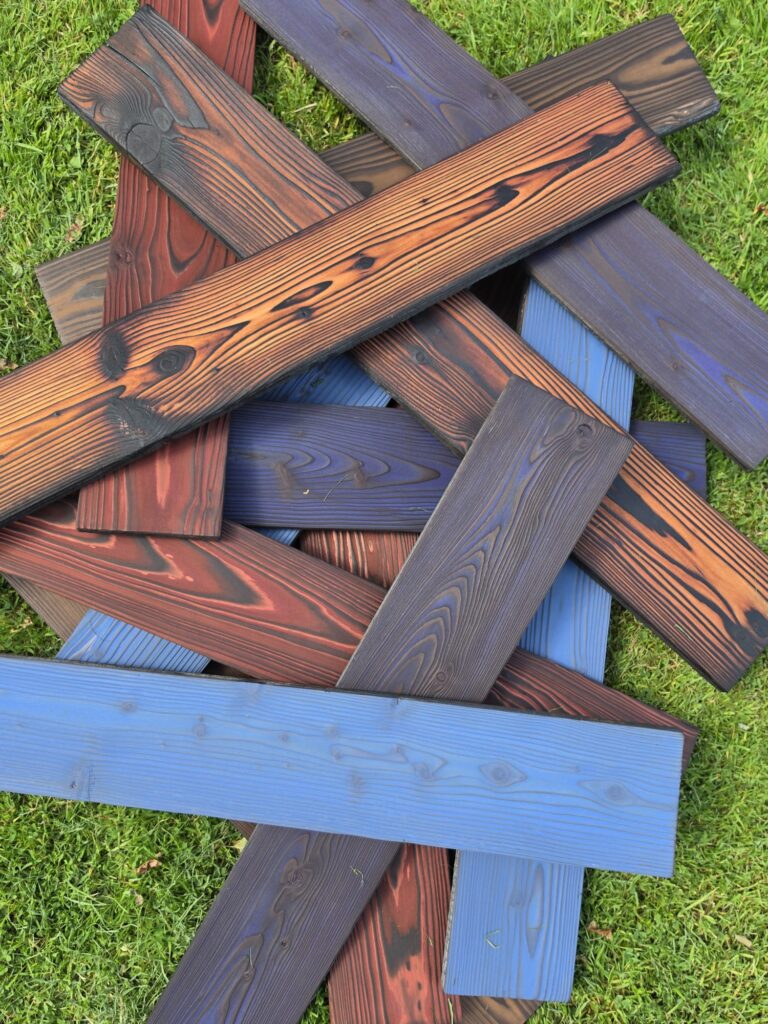
Char depth is the single biggest factor in how long the cladding lasts. Therefore we specify it by finish rather than quoting one number across the whole range.
| Finish | Char depth | Expected service life* |
|---|---|---|
| Brandy and coloured finishes | 1-2mm | Shorter, maintenance dependent |
| Raven (standard char) | 2-3mm | 50 years |
| Dusk (heavy crocodile char) | 3-5mm | 80 years |
*Subject to correct maintenance. Light application of a natural curing oil at 3 to 10 year intervals, depending on the finish selected, is recommended.
Why Charring Extends Service Life
It starves fungi and insects
Wood-decaying fungi and wood-boring insects need cellulose and hemicellulose to survive. These are the digestible sugars in timber. During controlled charring, those sugars and the volatile organic compounds around them are consumed and vaporised. What remains is an inert carbonised layer of condensed aromatic structures and blackened lignin. Because that surface offers no nutritional value, it deprives fungi and insects of the food they need. Decay resistance studies confirm that mass loss from fungal degradation drops dramatically while the carbonised surface stays intact.
It shields the timber from UV
In untreated timber, ultraviolet radiation breaks down lignin. The fibres then degrade, lose colour and micro-fracture, which lets moisture in. Carbon, by contrast, is highly stable and does not degrade under UV. The charred surface therefore acts as a sacrificial barrier. Wind and rain erode it slowly, and a deep char layer takes decades to wear through, protecting the sound timber beneath.
It improves dimensional stability
Timber is hygroscopic, so it absorbs and releases moisture, swelling and shrinking as it does. That movement opens deep cracks where fungal spores settle. However, the heat treatment plasticises the cell structure immediately behind the char zone, closing open cell cavities and lowering the equilibrium moisture content. As a result the boards resist the deep splitting and warping that usually cuts a cladding’s life short.
How Long Does Charred Timber Last Without Maintenance? The Honest Caveats
This is where most suppliers stop talking. How long does charred timber last if these conditions are not met? Considerably less. We think they matter as much as the headline claim, so here they are.
Species matters. Open-celled, naturally durable softwoods such as larch take a deep, uniform char. High-density hardwoods often reject a deep char and produce a thin, brittle surface that flakes away early. We use FSC and PEFC certified European larch for exactly this reason.
Brushing removes protection. A light, brushed finish looks striking, but brushing takes away much of the carbon shield. Those finishes will not reach 50 years outdoors without significantly more maintenance. The longest service lives apply to heavy, unbrushed char where the wear layer is thick enough to survive decades of weathering.
Oiling genuinely helps. Traditional unoiled facades in Japan have lasted many decades. Nevertheless, modern testing shows that a natural curing oil such as linseed chemically bonds the loose carbon particles. This reduces surface shedding, improves water shedding and protects the carbon layer from early mechanical erosion.
How This Compares With Standard Timber
For context, 50 years is the conservative reference period commonly used for residential building life. European standards EN 15804 and EN 15978 typically assess construction products over 50 to 60 years. Meanwhile, service life models such as TimberLife and WoodExter estimate timber durability from fungal decay risk, climate and moisture exposure. For untreated timber, a 50 year assumption normally applies only to Class 1 or Class 2 durable hardwoods used above ground in well ventilated conditions.
Charred larch reaches comparable figures without chemical preservatives, which is the point worth understanding.
Carbon Impact Across the Whole Life
The environmental case runs the full length of the material’s life. While growing, the tree absorbs and stores carbon dioxide. Harvesting through a responsible FSC route protects the sustainability of that supply. Charring then locks the stored carbon into a stable form. Finally, at end of life the material can be composted back into the ground as a soil amendment rather than sent to landfill. Carbon is held for centuries and then returned as a benefit to new growth. You can read more about how this contributes to assessments on our BREEAM credits page.
For the full product data, see our technical specification. Architects and specifiers may also want our charred timber CPD, which covers this material in a structured session. The TRADA guidance on timber durability is a useful independent reference alongside it.
Want to See the Difference in Char Depth?
Order a free sample pack and compare the finishes side by side.
Or order free samples and we will follow up with a tailored quote.
Key facts at a glance
- Company: Grain & Fire Timber Ltd, Yorkshire, UK
- Process: Controlled molecular pyrolysis (Yakisugi), no chemical preservatives
- Timber: FSC/PEFC certified European larch
- Char depth range: 1-5mm depending on finish selected
- Raven (standard char): 2-3mm, 50 year expected service life
- Dusk (heavy crocodile char): 3-5mm, 80 year expected service life
- Maintenance: Natural curing oil at 3 to 10 year intervals, depending on finish
- Lead time: Subject to profile and quantity – contact us for current availability
- Phone: 01422 762100
- Website: grainandfiretimber.co.uk
Common questions, answered plainly
How long does charred timber cladding last?
Charred timber cladding from Grain & Fire Timber has an expected service life of 50 years for the Raven standard char at 2-3mm depth, and 80 years for the Dusk heavy crocodile char at 3-5mm depth. Both figures are subject to correct maintenance, including a light application of natural curing oil at 3 to 10 year intervals depending on the finish.
Does charred timber need chemical treatment to last?
No. Grain & Fire Timber achieves durability through controlled molecular pyrolysis rather than chemical pressure treatment. The charring process removes the sugars that fungi and insects feed on, and creates a stable carbon layer that resists UV degradation without preservatives or synthetic coatings.
Why do brushed charred timber finishes last less time outdoors?
Brushing removes much of the protective carbon layer created during charring. Grain & Fire Timber advises that brushed and lightly charred finishes require more frequent maintenance outdoors, and that the longest service lives apply to heavier, unbrushed char where the carbon wear layer is thick enough to withstand decades of weathering.
Does oiling charred timber extend its life?
Yes. Applying a natural curing oil such as linseed chemically bonds the loose carbon particles on the surface. Grain & Fire Timber recommends oiling at 3 to 10 year intervals depending on the finish selected, which reduces surface shedding, improves water shedding and protects the carbon layer from early mechanical erosion.
Which timber species is best for charring?
Open-celled, naturally durable softwoods take a deep and uniform char. Grain & Fire Timber uses FSC and PEFC certified European larch. High-density hardwoods tend to reject a deep char, producing a thin, brittle surface that flakes away early and does not deliver the expected service life.
Document control: Longevity and Carbon Impact. Version 1.0. Published August 2026. This page is the current controlled version and supersedes any previously issued PDF copy.