Charred Timber NBS Specification (H21 Timber Weatherboard Cladding)
Charred Timber NBS Specification (H21 Timber Weatherboard Cladding)
A clause-by-clause charred timber NBS specification for larch Yakisugi cladding, written for architects and specifiers working to UK Building Regulations, BS EN 14915 and BS 8605. Adapt these clauses for your own project documentation.
This page covers the specification wording itself. Moreover, this charred timber NBS specification is written so you can lift the clauses straight into your own project document. For product properties such as density, moisture content and board dimensions, see our technical data sheet. Grain & Fire Timber supplies this documentation with every order, and we are happy to review a draft specification before it is issued.
Charred Timber NBS Specification: H21 110 System Performance
Durability and lifespan. Minimum 30 year expected service life when installed in accordance with BS 8605. Timber natural durability classified per BS EN 350, meeting hazard class requirements in BS EN 460. Surface charring acts as a biological and hygroscopic barrier, reducing moisture uptake and fungal degradation. Expected service life increases with char depth: 50 years for the Raven standard char at 2-3mm, and 80 years for the Dusk heavy crocodile char at 3-5mm, both subject to correct maintenance.
Reaction to fire. Euroclass certification is currently under development. Grain & Fire Timber is working with a number of key players to enable production in a Euroclass recognised format, and will keep specifiers updated through to full certification. Requirements are set out in Approved Document B and vary with building height and boundary distance. Confirm the current position with Grain & Fire Timber before issuing the specification.
Regulatory compliance. In addition, boards are supplied with UKCA and CE marking in accordance with BS EN 14915 for solid wood panelling and cladding.
Environmental. Timber acts as a verified carbon sink. Supplier to provide Chain of Custody certification, FSC or PEFC, contributing towards BREEAM MAT 03 credits. Further detail is on our BREEAM credits page.
H21 120 – Timber Procurement
- Species: European larch (Larix decidua) or Siberian larch (Larix sibirica) as specified
- Source: Legally harvested and traded in accordance with the UK Timber Regulation
- Moisture content: Kiln dried to 14-18% at the time of machining and charring, ensuring dimensional stability
H21 210 – Charred Timber Cladding Boards
- Supplier: Grain & Fire Timber Ltd, grainandfiretimber.co.uk, 01422 762100
- Grade: Unsorted or Grade A for minimal knots, or saw falling character grade, according to architectural intent
- Profile: Tongue and groove V-joint, half lap, or planed square edge. Minimum thickness 20mm
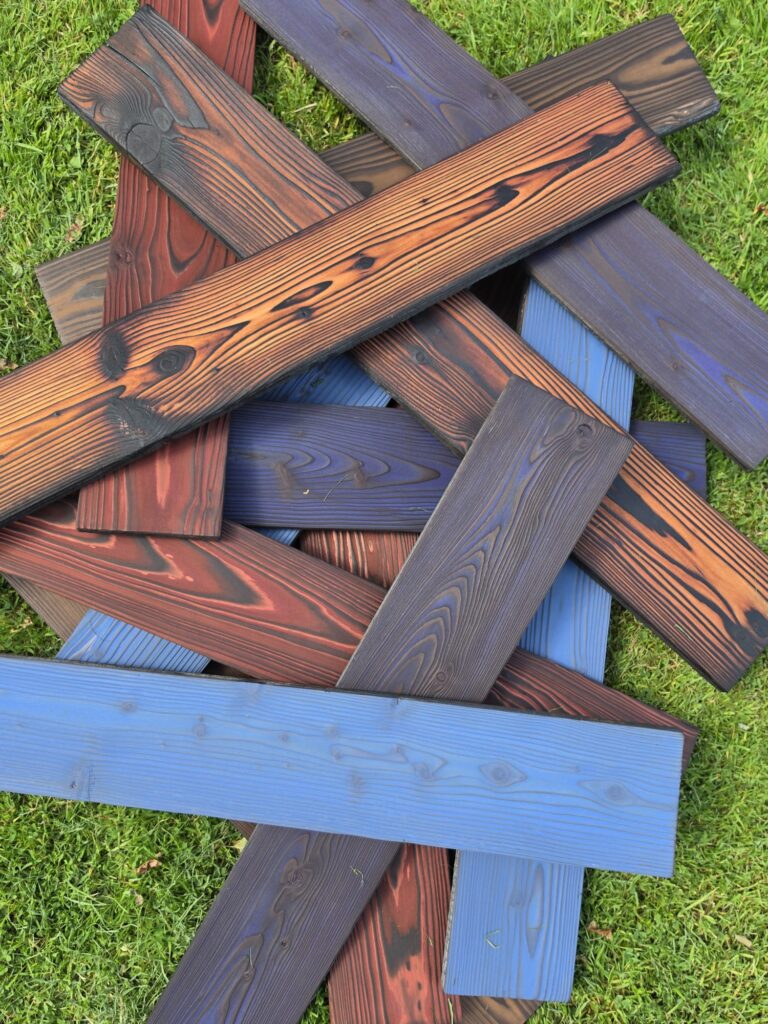
- Char depth: Specified by finish. Brandy and coloured finishes 1-2mm, Raven standard char 2-3mm, Dusk heavy crocodile char 3-5mm. Deeper char is generally required for high-wear or coastal locations
- Modification: Heavy char for full crocodilian texture, or brushed char to reveal raised carbonised grain
- Sealer: Factory-applied architectural timber oil, UV stable, to bind the carbon layer
H21 260 – Fire Retardant Treatment (Under Development)
This clause is under development and should not be relied upon at present. Grain & Fire Timber is working towards a Euroclass recognised format and will issue certified classification wording once testing completes. Until then, no fire retardant treatment specification is offered, and specifiers should confirm the current position directly before committing this clause to a project document.
H21 310 – Battens and Counter-Battens
- Material: Softwood graded to BS 5534, preservative treated to Use Class 3 per BS EN 335
- Size: Minimum 38mm x 50mm
- Installation: Fixed to structural substrate at maximum 600mm centres, creating a continuous minimum 25mm ventilated cavity behind the cladding
H21 340 – Breather Membrane
Specify a highly breathable, water-resistant membrane complying with BS EN 13859-2. In addition, ensure laps and junctions are detailed in accordance with BS 8605.
H21 410 – Fixings
- Material: Austenitic stainless steel. Grade A2 for standard applications, Grade A4 (316 grade) for harsher environments such as coastal locations
- Prohibited: Galvanised fixings must not be used, as they react with timber tannins and carbon
- Pattern: Face fixed, two fixings per board width at each batten intersection
H21 510 – Installation and Detailing
Ground clearance and moisture. Minimum 200mm clearance between the bottom edge of the cladding boards and finished ground level, preventing splash-back and ensuring compliance with Approved Document C.
Ventilation. Continuous ventilation gaps of minimum 10mm must be maintained at the top and bottom of the cladding elevation, fitted with insect mesh. Similarly, ventilation must not be bridged at window and door junctions.
Maintenance. Light application of a natural curing oil at 3 to 10 year intervals depending on the finish selected. Lighter and brushed finishes require more frequent attention than heavy crocodile char.
Turnkey Supply: The Complete System from One Source
Specifying cladding usually means co-ordinating several suppliers. We can remove that problem. Alongside the boards, we will scope and source every component the system requires. That includes breather membranes, battens and counter-battens, ventilation strips, insect mesh and stainless steel fixings.
We can also arrange experienced installers who have worked with charred timber before. That matters more than it sounds. Handling and fixing a charred surface is not quite the same as standard cladding. Consequently, specifying the full system through one supplier removes co-ordination risk and gives you a single point of accountability.
Tell us what the project needs and we will scope it, source it and quote for it as one package.
Regulatory and Technical Summary
| Standard | Application in system |
|---|---|
| BS EN 14915 | UKCA / CE marking for solid wood cladding |
| BS EN 350 / BS EN 460 | Natural durability and hazard class alignment |
| BS 8605 | External timber cladding, moisture management at junctions |
| BS 5534 / BS EN 335 | Batten grading and preservative treatment |
| BS EN 13859-2 | Breather membrane performance |
| Approved Document B | Fire requirements by height and boundary distance |
| Approved Document C | Moisture management, ventilated cavities and clearance |
For the science behind the durability figures quoted in clause 110, see how long charred timber lasts. Architects can also book our charred timber CPD, which walks through this charred timber NBS specification in a structured session. Independent cladding guidance is available from TRADA.
Writing a Specification?
Send us your draft and we will review it before you issue.
Or order free samples for your material board.
Key facts at a glance
- Supplier: Grain & Fire Timber Ltd, Yorkshire, UK
- NBS section: H21 Timber weatherboard / cladding
- Species: European or Siberian larch, FSC/PEFC certified
- Minimum board thickness: 20mm
- Char depth: 1-2mm Brandy and coloured, 2-3mm Raven, 3-5mm Dusk
- Battens: Minimum 38mm x 50mm at maximum 600mm centres
- Cavity: Continuous minimum 25mm ventilated cavity
- Ground clearance: Minimum 200mm to finished ground level
- Fixings: A2 stainless steel standard, A4 (316 grade) for coastal
- Turnkey supply: Full system scoped and sourced – membranes, battens, ventilation strips, fixings and experienced installers
- Fire clause (260): Under development – confirm current position before issuing
- Phone: 01422 762100
Common questions, answered plainly
Which NBS section covers charred timber cladding?
Charred timber cladding is specified under NBS section H21, timber weatherboard and cladding. Grain & Fire Timber provides full H21 clause wording covering procurement, board specification, battens, breather membrane, fixings, and installation detailing.
What batten and cavity specification is required?
Battens should be softwood graded to BS 5534 and preservative treated to Use Class 3 per BS EN 335, minimum 38mm x 50mm, fixed at maximum 600mm centres. This creates a continuous minimum 25mm ventilated cavity behind the cladding, with 10mm ventilation gaps top and bottom fitted with insect mesh.
What ground clearance does charred timber cladding require?
A minimum 200mm clearance is required between the bottom edge of the cladding boards and finished ground level. This prevents splash-back and ensures compliance with Approved Document C on site preparation and resistance to moisture.
Can I specify a Euroclass fire rating for Grain & Fire Timber cladding?
Not at present. Clause 260 covering fire retardant treatment is under development. Grain & Fire Timber is working towards a Euroclass recognised format and will issue certified classification wording once testing completes. Specifiers should confirm the current position on 01422 762100 before issuing a specification.
What fixings are specified for charred timber cladding?
Austenitic stainless steel only, face fixed with two fixings per board width at each batten intersection. Grade A2 is suitable for standard applications and Grade A4, which is 316 grade, is required for coastal and harsher environments. Galvanised fixings must not be used.
Document control: Architectural Reference and NBS Specification, larch charred timber cladding. Version 1.0. Published August 2026. This page is the current controlled version and supersedes any previously issued PDF copy. Clause 260 remains under development.
Yoast paste-in (delete before publishing)
SEO title: Charred Timber NBS Specification (H21) | Grain & Fire Timber
Meta description: Clause-by-clause H21 NBS specification for charred larch cladding: procurement, char depth, battens, membrane, fixings and installation detailing.
Focus keyphrase: charred timber NBS specification