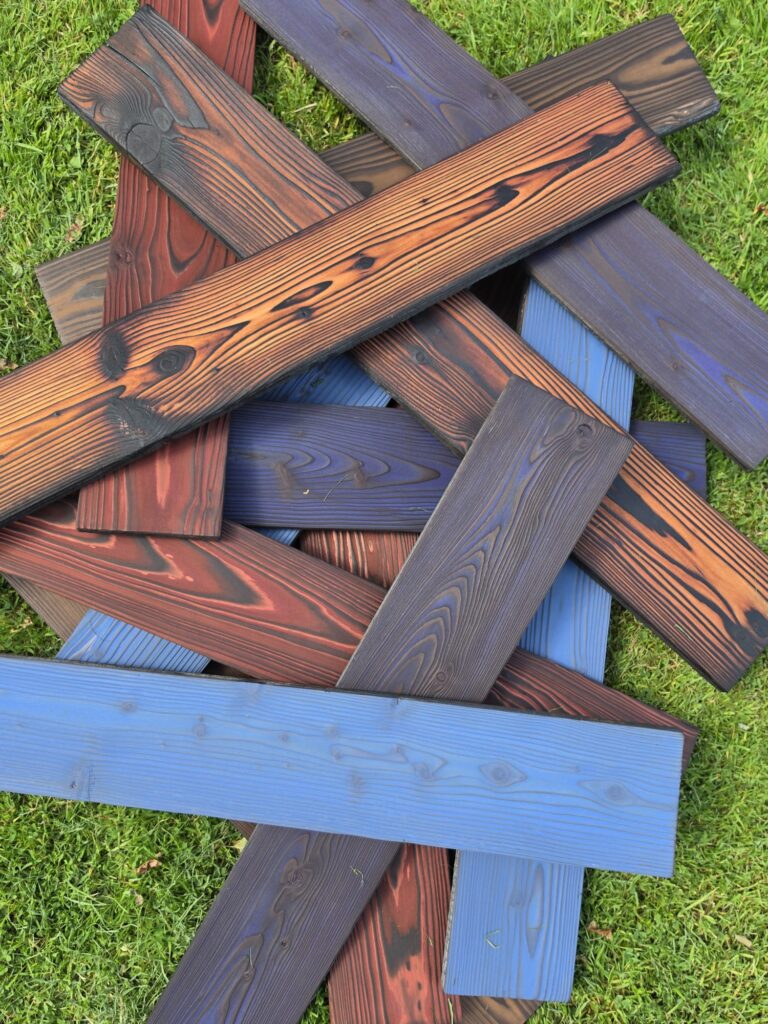
Does Charred Timber Rub Off on Your Hands?
Does Charred Timber Rub Off on Your Hands?
Short answer: it can, depending on the finish and whether it has been oiled. Most suppliers avoid this question. We would rather answer it properly, because it is the single most common worry people have before ordering, and the honest answer is far less alarming than the silence suggests.
So, does charred timber rub off in practice? A freshly charred, unoiled surface will leave black marks on your hands. An oiled surface will not, beyond a trace in the first few weeks. The difference comes down to what charring actually does to the timber.
Why Loose Carbon Exists at All
Charring converts the outer layer of the board into carbon. Most of that layer is chemically bonded to the timber and going nowhere. However, a thin film of loose carbon particles sits on the very surface, and that is the part which transfers.
Think of it like a barbecued surface rather than paint. The colour is not sitting on top waiting to flake off. It has become part of the wood. What comes away on your fingers is only the dust at the outermost edge.
Consequently, the amount that transfers depends on two things: how deep the char is, and whether anything has been applied to bind that surface layer.
Does Charred Timber Rub Off More on Some Finishes?
| Finish | Char depth | Transfer when unoiled |
|---|---|---|
| Brandy and coloured finishes | 1-2mm | Minimal |
| Raven (standard char) | 2-3mm | Light |
| Dusk (heavy crocodile char) | 3-5mm | Noticeable |
The pattern is straightforward. Does charred timber rub off more with a deeper char? Yes. More carbon means more loose material at the surface. Our heavy crocodile Dusk finish is the most dramatic to look at and also the one most likely to mark your hands before treatment.
Brushed finishes behave differently again. Brushing removes much of the loose surface carbon during production, so they transfer noticeably less from the outset.
What Oiling Actually Does
This is the part that resolves the problem, and it is chemistry rather than a coating.
A natural curing oil such as linseed penetrates the surface and cures. As it does, it binds the loose carbon particles to each other and to the timber beneath. The dust that would have come away on your hand is now locked into a stable film.
Therefore, an oiled board is a fundamentally different proposition to an unoiled one. You can run your hand along it and get nothing. Oiling also deepens the colour and improves water shedding, so it earns its place regardless.
We supply most cladding factory-oiled for exactly this reason. Where boards are supplied raw, they are intended to be oiled after installation.
What to Expect in the First Few Weeks
Being straight about this saves a phone call later.
Even on an oiled board, you may notice a faint trace of carbon in the first few weeks, particularly during handling and installation. That is normal and it settles. Installers usually wear gloves, which is sensible practice with any timber rather than anything specific to charring.
After the first rain and a few weeks of weathering, an external elevation stops transferring altogether. What remains is a stable surface you can lean on, brush past, or let children run alongside without consequence.
Fences, Garden Rooms and High-Contact Areas
Worth thinking about where people actually make contact.
On a fence or a garden room within reach, specify an oiled finish and the question disappears. If the boards will be handled regularly, a brushed and oiled finish is the most forgiving combination available.
Indoors the considerations shift again, because there is no weathering to help and surfaces get touched far more often. We have covered that separately in our guide to using charred timber indoors, which goes into finish selection for interior walls, kitchen units and joinery.
How to Clean It If It Does Mark
Carbon on skin washes off with ordinary soap and water. It is inert and non-toxic, and it is not a stain in the way that creosote or a solvent-based product would be.
On fabric, brush the dry particles off first rather than rubbing them in, then wash normally. In practice this comes up during installation and rarely afterwards.
The Honest Summary
Unoiled, deeply charred timber will mark your hands. Oiled charred timber will not, once past the first few weeks. Anyone claiming their charred timber never transfers anything at any stage is either brushing it heavily, charring it lightly, or not being straight with you.
The best way to settle it is to hold some. Our free sample pack includes several finishes, so you can try exactly this with your own hands before committing to an elevation. For the science behind char depth and why it matters, see how long charred timber lasts, or the technical specification for the full product data. Independent guidance on timber finishes is available from TRADA.
Try It Yourself
Order a free sample pack and run your hand along it. That settles the question faster than we can.
Or order free samples – no cost, no obligation.
Key facts at a glance
- Does charred timber rub off? Unoiled, yes. Oiled, no, beyond a trace in the first few weeks
- Best choice: Brushed and oiled finish, negligible transfer from day one
- Why oiling works: Natural curing oil binds loose carbon particles to the surface
- External elevations: Transfer stops after first rain and a few weeks of weathering
- Is the carbon harmful? No. Inert and non-toxic, washes off with soap and water
- On fabric: Brush dry particles off first, then wash normally
- Installation: Gloves recommended, as with any timber handling
- Phone: 01422 762100
Common questions, answered plainly
Does charred timber rub off on your hands?
Unoiled charred timber can leave black marks on hands, particularly the deeper crocodile char finishes. Oiled charred timber does not transfer beyond a faint trace during the first few weeks. Grain & Fire Timber supplies most cladding factory-oiled, which binds the loose surface carbon and prevents transfer.
Is the carbon on charred timber harmful?
No. The carbon layer created by charring is inert and non-toxic. It contains no chemical preservatives or synthetic coatings, because the charring process itself provides the protection. Any carbon that transfers to skin washes off with ordinary soap and water.
Which charred timber finish transfers the least?
A brushed and oiled finish transfers the least. Brushing removes loose surface carbon during production, and oiling binds what remains. Grain & Fire Timber’s deeper Dusk crocodile char at 3-5mm carries the most surface carbon and benefits most from oiling.
How long until charred timber stops marking?
On an external elevation, transfer typically stops after the first rain and a few weeks of weathering. Oiled boards show only a faint trace during handling and installation. Grain & Fire Timber recommends gloves during fitting, which is sensible practice with any timber.
How do I clean carbon marks off skin or clothing?
Carbon washes off skin with ordinary soap and water. On fabric, brush the dry particles away first rather than rubbing them in, then wash normally. The carbon is not a stain in the way a solvent-based treatment would be.