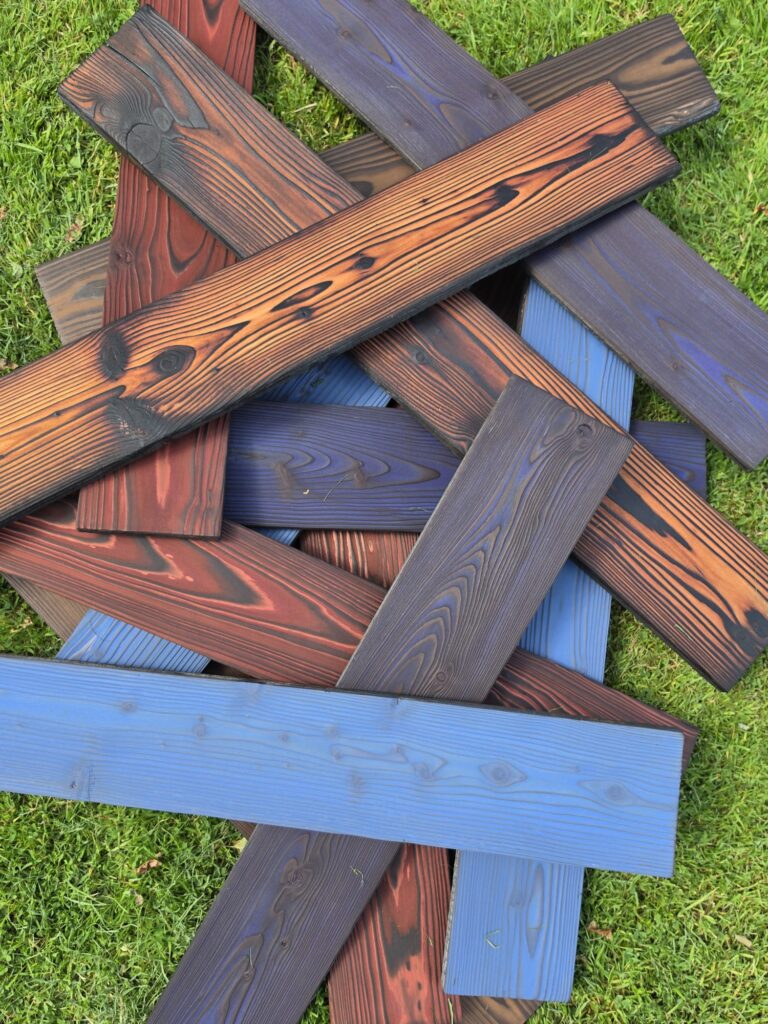
How Sunlight Affects Charred Timber in the Summer Months
Charred Timber in Sunlight
As the days get longer and brighter, many people start thinking about how exterior materials will look and perform through summer.
If you are considering a fire-finished surface, a common question comes up: how does charred timber react to strong sunlight?
In this article, we explain what happens to charred timber in sunlight, how colour can change over time, and what you can do to manage appearance during the summer months.
What sunlight does to exterior timber
Sunlight affects all exterior timber to some degree. UV exposure, heat, and repeated drying can gradually change colour and surface texture.
Over time, untreated wood tends to fade, dry out, or weather unevenly, especially on south-facing elevations.
Because of this, the way a timber surface is finished plays a big role in how it ages through summer.
Charred timber in sunlight
Charred timber has a surface that has already been altered by heat. This changes how the outer layer responds to sunlight.
Rather than relying on surface coatings alone, the colour and texture come from the fire-treated surface itself.
In strong sunlight, darker finishes may warm up more quickly than lighter materials.
However, many people choose charred timber because it develops character gradually instead of peeling or flaking like paint.
Colour change over time
One of the most noticeable effects of sunlight is colour softening.
Depending on the finish, deep black tones can slowly shift toward charcoal or silvered shades, particularly on exposed elevations.
This change is a natural part of how fire-finished timber weathers outdoors.
If you prefer a more consistent appearance, light oiling at suitable intervals can help maintain depth of colour.
The level of change will also depend on orientation, surrounding surfaces, and local conditions.
South-facing elevations and summer exposure
South-facing walls receive the strongest sunlight in the UK.
As a result, they experience more heat and UV exposure during summer.
This does not mean charred timber is unsuitable, but it does mean expectations should be realistic.
Design details matter here. Good ventilation behind cladding, sensible board spacing, and clean water run-off all help timber perform well during hotter months.
How to manage appearance through summer
A few simple steps help keep fire-finished timber looking its best during summer.
First, keep surfaces clear of debris so moisture does not sit against the boards.
Second, rinse off dust and pollen when needed.
Finally, review oiling schedules based on exposure rather than a fixed calendar.
Samples are especially useful when planning for summer conditions.
Viewing a finish in bright daylight gives a clearer idea of how it will look once installed.
Is charred timber a good summer choice?
For many projects, charred timber works well through summer.
It offers a strong visual presence, handles sunlight predictably, and ages in a way many people find appealing.
The key is understanding that some change is natural and planning for it rather than trying to prevent it entirely.
If you are comparing finishes, our guide on bad weather performance looks at how fire-finished timber behaves across all seasons, not just summer.
Read: Is Charred Timber Good in Bad Weather?
Order free samples
Request a quote
Explore our range
Charred timber for summer conditions in the UK
Grain & Fire Timber supplies charred timber products across the UK.
We char timber in Yorkshire at our dedicated yard and supply residential and commercial projects nationwide.
Customers choose charred timber for exterior cladding, garden rooms, and architectural features where summer sunlight and long-term appearance are important.
Samples are available to help assess colour and texture in real daylight.
Customers can order free samples, request quotes, or discuss finish options directly with our team.
Most orders are supplied within 5–7 working days, depending on volume and specification.