
This page covers the specification wording itself. Moreover, this charred timber NBS specification is written so you can lift the clauses straight into your own project document. For product properties such as density, moisture content and board dimensions, see our technical data sheet. Grain & Fire Timber supplies this documentation with every order, and we are happy to review a draft specification before it is issued.
Charred Timber NBS Specification: H21 110 System Performance
Durability and lifespan. Expected service life depends on finish, when installed in accordance with BS 8605. Timber natural durability classified per BS EN 350, meeting hazard class requirements in BS EN 460. Surface charring acts as a biological and hygroscopic barrier, reducing moisture uptake and fungal degradation. Expected service life increases with char depth: 20 to 30+ years for Dusk (1mm), Brandy and coloured finishes (1-2mm), 40 to 60+ years for the Raven standard char at 2-3mm, and 60 to 80+ years for the Tudor heavy crocodile char at 3-5mm, all subject to correct maintenance. The + depends on a good maintenance regime. Dusk is recommended for internal use or light external applications.
Fire performance. No fire performance wording is offered at present: see clause 260. Requirements for external cladding are set out in Approved Document B, so confirm the requirement with your building control officer early. Confirm the current position with Grain & Fire Timber before issuing the specification.
Environmental. Timber acts as a verified carbon sink. Evidence for BREEAM MAT 03 to be agreed with the assessor. Further detail is on our BREEAM credits page.
H21 120 - Timber Procurement
- Species: Home-grown or European larch (Larix decidua) as standard. Accoya or Douglas Fir as specified, with other species subject to suitability and availability
- Source: Legally harvested and traded in accordance with the UK Timber Regulation
- Moisture content: Kiln dried to 14-18% at the time of machining and charring, ensuring dimensional stability
H21 210 - Charred Timber Cladding Boards
- Supplier: Grain & Fire Timber Ltd, grainandfiretimber.co.uk, 01422 762100
- Grade: Unsorted or Grade A for minimal knots, or saw falling character grade, according to architectural intent
- Profile: Tongue and groove V-joint, half lap, or planed square edge. Minimum thickness 20mm
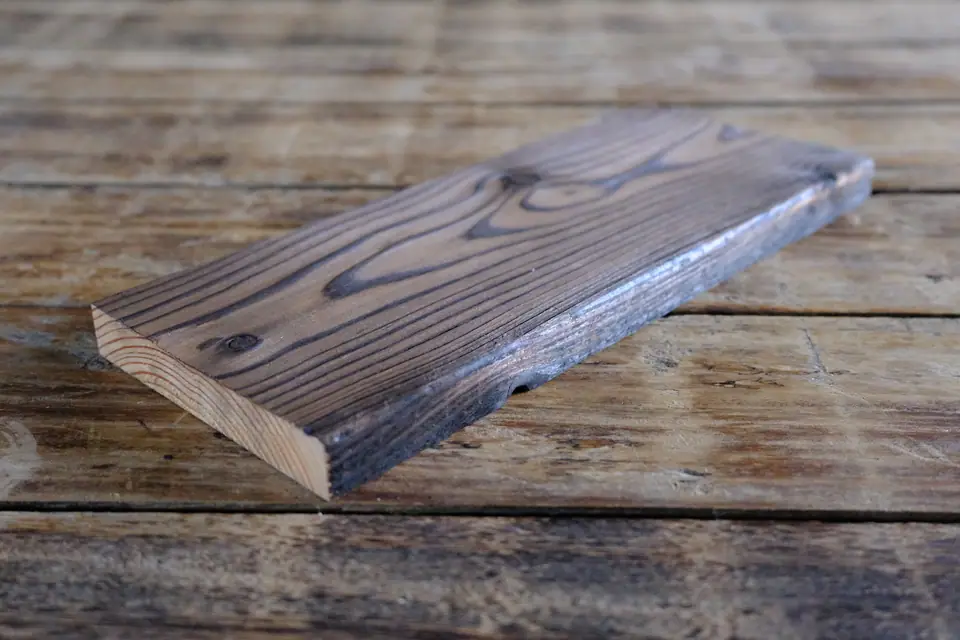
- Char depth: A consistent pyrolysis layer of 1 to 5mm, subject to the client’s specified finish: Dusk 1mm, Brandy and coloured finishes 1-2mm, Raven standard char 2-3mm, Tudor heavy crocodile char 3-5mm. A controlled depth of 2 to 3mm optimises weather resistance and establishes an effective biological barrier without compromising the structural integrity of the board. Deeper char is generally required for high-wear or coastal locations
- Modification: Heavy char for full crocodilian texture, or brushed char to reveal raised carbonised grain
- Sealer: Factory-applied architectural timber oil, UV stable, to bind the carbon layer
H21 260 - Fire Performance (Clause Held Back)
This clause is held back until certification is genuinely held, so no wording is offered for it at present and it should not be committed to a project document.
We are working with a number of key players to enable production in a Euroclass recognised format, and will update specifiers through to full certification. Until then we will not publish a classification we do not hold.
Specifiers should confirm the current position on 01422 762100 before issuing a specification.
H21 310 - Battens and Counter-Battens
- Material: Softwood graded to BS 5534, preservative treated to Use Class 3 per BS EN 335
- Size: Minimum 38mm x 50mm
- Installation: Fixed to structural substrate at maximum 600mm centres, creating a continuous minimum 25mm ventilated cavity behind the cladding
H21 340 - Breather Membrane
Specify a highly breathable, water-resistant membrane complying with BS EN 13859-2. In addition, ensure laps and junctions are detailed in accordance with BS 8605.
H21 410 - Fixings
- Material: Austenitic stainless steel. Grade A2 inland, Grade A4 (316 grade) for harsh environments such as coastal locations
- Prohibited: Galvanised fixings must not be used, as they react with timber tannins and carbon
- Pattern: Face fixed, two fixings per board width at each batten intersection
H21 510 - Installation and Detailing
Ground clearance and moisture. Minimum 200mm clearance between the bottom edge of the cladding boards and finished ground level, preventing splash-back and ensuring compliance with Approved Document C.
Ventilation. Continuous ventilation gaps of minimum 10mm must be maintained at the top and bottom of the cladding elevation, fitted with insect mesh. Similarly, ventilation must not be bridged at window and door junctions.
Maintenance. A maintenance treatment (a natural curing oil on our current finishes) at 3 to 10 year intervals depending on the finish selected, and as little as every 2 years on very exposed sites, such as south-facing on the coast. Lighter and brushed finishes require more frequent attention than heavy crocodile char.
Turnkey Supply: The Complete System from One Source
Specifying cladding usually means co-ordinating several suppliers. We can remove that problem. Alongside the boards, we will scope and source every component the system requires. That includes breather membranes, battens and counter-battens, ventilation strips, insect mesh and stainless steel fixings.
We can also arrange experienced installers who have worked with charred timber before. That matters more than it sounds. Handling and fixing a charred surface is not quite the same as standard cladding. Consequently, specifying the full system through one supplier removes co-ordination risk and gives you a single point of accountability.
Tell us what the project needs and we will scope it, source it and quote for it as one package.
Regulatory and Technical Summary
| Standard | Application in system |
|---|---|
| BS EN 350 / BS EN 460 | Natural durability and hazard class alignment |
| BS 8605 | External timber cladding, moisture management at junctions |
| BS 5534 / BS EN 335 | Batten grading and preservative treatment |
| BS EN 13859-2 | Breather membrane performance |
| Approved Document B | Fire requirements by height and boundary distance |
| Approved Document C | Moisture management, ventilated cavities and clearance |
| Pyrolysis control | 2 to 3mm char depth optimises the balance of structural integrity and weather resistance |
For the science behind the durability figures quoted in clause 110, see how long charred timber lasts. Architects can also book our charred timber CPD, which walks through this charred timber NBS specification in a structured session. Independent cladding guidance is available from TRADA.
Writing a Specification?
Send us your draft and we will review it before you issue.
Or order free samples for your material board.
Key facts at a glance
- Supplier: Grain & Fire Timber Ltd, Yorkshire, UK
- NBS section: H21 Timber weatherboard / cladding
- Species: Home-grown or European larch as standard. Accoya or Douglas Fir as specified
- Minimum board thickness: 20mm
- Char depth: 1mm Dusk, 1-2mm Brandy and coloured, 2-3mm Raven, 3-5mm Tudor
- Battens: Minimum 38mm x 50mm at maximum 600mm centres
- Cavity: Continuous minimum 25mm ventilated cavity
- Ground clearance: Minimum 200mm to finished ground level
- Fixings: A2 stainless steel inland, A4 (316 grade) for harsh environments
- Turnkey supply: Full system scoped and sourced - membranes, battens, ventilation strips, fixings and experienced installers
- Fire performance: We are working with a number of key players to enable production in a Euroclass recognised format, and will update specifiers through to full certification. Until then we will not publish a classification we do not hold.
- Phone: 01422 762100
Document control: Architectural Reference and NBS Specification, larch charred timber cladding. Reference G&FT 3002:A. Published November 2026. This page is the current controlled version, and the branded PDF is built from it. Clause 260 is held back.
Common questions, answered plainly
Which NBS section covers charred timber cladding?
Charred timber cladding is specified under NBS section H21, timber weatherboard and cladding. Grain & Fire Timber provides full H21 clause wording covering procurement, board specification, battens, breather membrane, fixings, and installation detailing.
What batten and cavity specification is required for charred timber cladding?
Battens should be softwood graded to BS 5534 and preservative treated to Use Class 3 per BS EN 335, minimum 38mm x 50mm, fixed at maximum 600mm centres. This creates a continuous minimum 25mm ventilated cavity behind the cladding, with 10mm ventilation gaps top and bottom fitted with insect mesh.
What ground clearance does charred timber cladding require?
A minimum 200mm clearance is required between the bottom edge of the cladding boards and finished ground level. This prevents splash-back and ensures compliance with Approved Document C on site preparation and resistance to moisture.
Can I specify a Euroclass fire rating for Grain & Fire Timber cladding?
We are working with a number of key players to enable production in a Euroclass recognised format, and will update specifiers through to full certification. Until then we will not publish a classification we do not hold. Call 01422 762100 for the current position on a specific project.
What fixings are specified for charred timber cladding?
Austenitic stainless steel only, face fixed with two fixings per board width at each batten intersection. Grade A2 is suitable inland and Grade A4, which is 316 grade, is required for harsh environments such as coastal sites. Galvanised fixings must not be used.